English is an important part of AFCAT preparation, and a strong performance in this section can significantly improve your overall score. Unlike subjects that may require extensive calculations or memorisation, English can be improved steadily through concept building, vocabulary development, regular reading, previous-year question practice and timed tests.
For aspirants searching for the best AFCAT coaching in Kerala, it is important to choose a preparation approach that combines classroom guidance with consistent self-practice. Even with good coaching, your English score will improve only when you regularly apply what you learn.
This comprehensive guide explains the most effective AFCAT English preparation tips, important topics to study, how to improve vocabulary and grammar, how to practise smartly, common mistakes to avoid and how coaching can support your preparation.
Why Is English Important for AFCAT?
English tests more than just vocabulary.
AFCAT English preparation requires candidates to develop:
- Grammar knowledge
- Vocabulary
- Reading comprehension
- Sentence understanding
- Error identification
- Contextual understanding
- Speed
- Accuracy
A candidate who develops strong English fundamentals can often solve familiar questions quickly, making English an important component of overall time management.
The key is not to study English randomly.
Use:
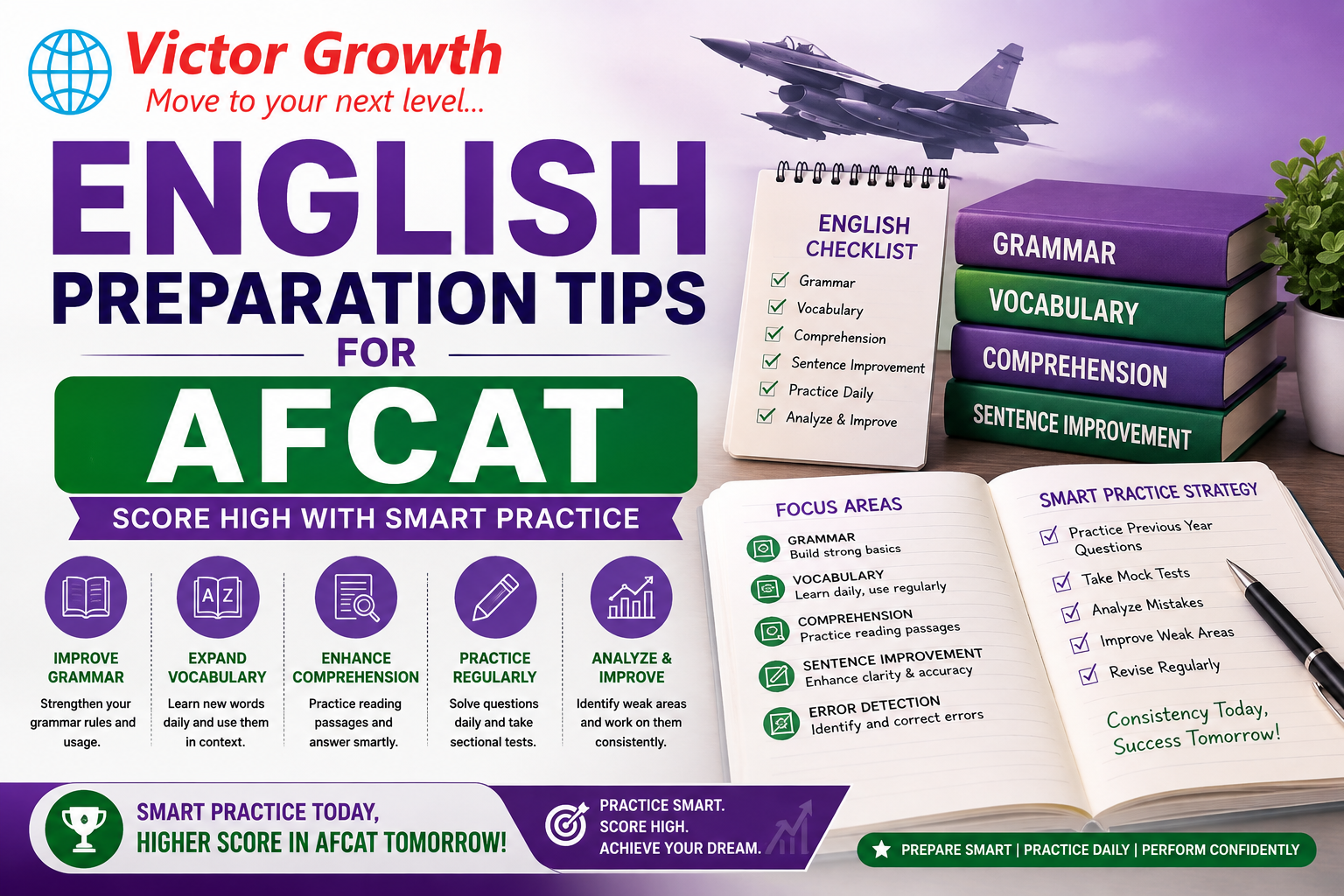
Learn → Practise → Analyse → Revise → Repeat
AFCAT English Preparation: Important Topics
Before creating a study plan, understand the major areas you should prepare.
Important English topics include:
Vocabulary
- Synonyms
- Antonyms
- One-word substitutions
- Idioms and phrases
- Word meanings
- Contextual vocabulary
Grammar
- Parts of speech
- Nouns
- Pronouns
- Adjectives
- Adverbs
- Verbs
- Tenses
- Articles
- Prepositions
- Conjunctions
- Subject-verb agreement
- Active and passive voice
- Direct and indirect speech
Sentence-Based Questions
- Error detection
- Sentence correction
- Sentence improvement
- Fill in the blanks
- Sentence completion
Reading Skills
- Reading comprehension
- Understanding context
- Identifying the main idea
- Finding specific information
- Drawing conclusions
Top 12 English Preparation Tips for AFCAT
1. Understand the AFCAT English Syllabus
The first mistake many aspirants make is starting preparation without understanding what they actually need to study.
Create a topic checklist covering:
- Vocabulary
- Grammar
- Comprehension
- Sentence correction
- Error detection
- Idioms
- Synonyms and antonyms
- One-word substitutions
Then assess your current level in each area.
This helps you create a focused preparation plan.
2. Build Your Vocabulary Every Day
Vocabulary cannot usually be mastered overnight.
Instead of trying to memorise hundreds of words in a single day, develop a daily habit.
A practical routine:
10–15 new words + revision of previously learned words
For each word, learn:
- Meaning
- Synonym
- Antonym
- Example sentence
- Word family, where useful
For example:
Abundant
Meaning: Available in large quantities
Synonym: Plentiful
Antonym: Scarce
Example: The region has abundant natural resources.
Learning words in context makes them easier to remember.
3. Use Root Words to Improve Vocabulary
Memorising isolated words can be difficult.
Learning common prefixes, suffixes and roots can help you understand unfamiliar vocabulary.
For example:
“Bio” relates to life.
This can help you connect words such as:
- Biology
- Biography
- Biodegradable
- Biosphere
This approach can make vocabulary learning more systematic.
4. Strengthen Your Grammar Fundamentals
Grammar is one of the most important foundations of AFCAT English preparation.
Instead of memorising random rules, understand how sentences are constructed.
Focus especially on:
Subject-Verb Agreement
Example:
Incorrect: The students is preparing for the examination.
Correct: The students are preparing for the examination.
Articles
Understand when to use:
- A
- An
- The
Prepositions
Practise common combinations such as:
- Interested in
- Good at
- Responsible for
- Afraid of
Tenses
Understand how different tenses change the meaning of a sentence.
5. Practise Error Detection
Error detection questions test your ability to identify grammatical mistakes.
When practising, do not simply identify the incorrect part.
Ask:
Why is it wrong?
For example, if you identify a subject-verb agreement error, revise the relevant rule.
Create an error notebook containing:
- Incorrect sentence
- Correct sentence
- Grammar rule
- Similar examples
Review it regularly.
6. Improve Reading Comprehension
Reading comprehension tests your ability to understand written information quickly and accurately.
To improve:
- Read regularly
- Avoid reading word by word
- Identify the main idea
- Pay attention to keywords
- Understand the author’s argument
- Practise answering questions within a time limit
Daily Reading Practice
Spend around 15–20 minutes reading quality English content.
You can use:
- Editorial-style articles
- Informative articles
- Defence-related articles
- Science and technology articles
- General-interest articles
The objective is to improve both comprehension and reading speed.
7. Read in English Every Day
One of the most effective long-term strategies is regular reading.
Reading improves:
- Vocabulary
- Sentence structure
- Grammar awareness
- Comprehension
- Reading speed
You don’t need to read for hours.
Even 15–30 minutes every day can make a difference when maintained consistently.
8. Practise Synonyms and Antonyms Strategically
Do not try to memorise endless lists.
Instead, organise vocabulary into groups.
For example:
Positive
- Happy
- Joyful
- Cheerful
- Delighted
Negative
- Sad
- Miserable
- Gloomy
- Depressed
Understanding relationships between words makes revision easier.
9. Learn Idioms and Phrases in Context
Idioms can be difficult when memorised as isolated phrases.
Instead, learn the meaning and use them in sentences.
For example:
“Break the ice”
Meaning: To initiate a conversation or make people feel more comfortable.
Learning the phrase through a sentence helps you remember its meaning.
10. Solve AFCAT Previous-Year Questions
Previous-year questions are extremely useful for understanding the examination style.
They help you identify:
- Common grammar concepts
- Vocabulary patterns
- Question formats
- Difficulty levels
- Areas requiring additional practice
Follow this process:
Attempt → Check → Understand → Record Mistake → Revise
Do not simply memorise the correct answer.
11. Practise English Under Time Pressure
Knowing English is different from solving English questions quickly during an examination.
Start with untimed practice.
Then move to:
Untimed → Timed Topic Practice → Sectional Tests → Full-Length Mock Tests
This gradually builds speed.
12. Analyse Your Mistakes
This is one of the most important AFCAT English preparation tips.
After every test, classify your mistakes.
Vocabulary Mistake
You didn’t know the word.
Grammar Mistake
You didn’t understand the rule.
Comprehension Mistake
You misunderstood the passage.
Careless Mistake
You knew the answer but selected incorrectly.
Time-Management Mistake
You spent too much time on the question.
Each type requires a different solution.
AFCAT English Vocabulary Preparation Strategy
Vocabulary is a long-term preparation area.
Use a three-step method:
Step 1: Learn
Learn new words every day.
Step 2: Use
Write or speak a sentence using the word.
Step 3: Revise
Review the word after a few days.
A useful revision pattern is:
Day 1 → Day 3 → Day 7 → Day 15 → Day 30
This spaced-revision approach can help improve retention.
How to Create an AFCAT Vocabulary Notebook
Divide your notebook into sections:
Synonyms
Word → Synonyms
Antonyms
Word → Opposite
Idioms
Phrase → Meaning
One-Word Substitutions
Description → Word
Difficult Words
Word → Meaning + Example
Keep the notebook concise.
The purpose is quick revision rather than creating another large textbook.
AFCAT Grammar Preparation Strategy
Do not attempt to memorise every grammar rule available.
Focus on commonly tested concepts.
High-Priority Areas
Subject-Verb Agreement
Understand singular and plural subjects.
Tenses
Know how verb forms change according to time.
Articles
Understand the use of “a,” “an” and “the.”
Prepositions
Learn commonly tested combinations.
Pronouns
Check whether pronouns correctly refer to their antecedents.
Conjunctions
Understand how words and clauses are connected.
Active and Passive Voice
Practise converting sentences correctly.
Direct and Indirect Speech
Understand changes in tense, pronouns and reporting verbs.
AFCAT English Practice Routine
A simple daily routine can look like this:
| Activity | Time |
|---|---|
| Vocabulary | 20 minutes |
| Grammar | 25 minutes |
| Question practice | 30 minutes |
| Reading | 20 minutes |
| Revision | 15 minutes |
Total: approximately 2 hours
You can reduce or increase the duration depending on your overall AFCAT study schedule.
Weekly AFCAT English Study Plan
Monday
Grammar + Vocabulary
Tuesday
Error Detection + Vocabulary
Wednesday
Sentence Improvement + Grammar
Thursday
Reading Comprehension + Vocabulary
Friday
Synonyms + Antonyms + Grammar
Saturday
Previous-Year Questions
Sunday
Sectional Test + Mistake Analysis
This structure ensures that every important skill receives regular attention.
How to Improve AFCAT English Score From a Low Level
If your English fundamentals are weak, don’t immediately start with difficult questions.
Follow a gradual progression.
Stage 1: Basic Grammar
Learn fundamental rules.
Stage 2: Basic Vocabulary
Build a core word bank.
Stage 3: Topic-Wise Questions
Practise individual question types.
Stage 4: Mixed Practice
Combine grammar and vocabulary questions.
Stage 5: Timed Tests
Improve speed and accuracy.
Stage 6: Full Mock Tests
Practise English within the complete examination environment.
This gradual approach prevents you from becoming overwhelmed.
How to Improve English If You Are Already Strong
If your English is already good, don’t spend most of your preparation time reading basic grammar rules.
Focus on:
- Previous-year questions
- Advanced vocabulary
- Speed
- Accuracy
- Mock tests
- Difficult comprehension
- Mistake analysis
Your objective should shift from learning to performance optimisation.
Common Mistakes AFCAT Aspirants Make in English
1. Memorising Vocabulary Without Revision
Words quickly become forgotten without regular revision.
2. Ignoring Grammar Fundamentals
Strong vocabulary cannot compensate for weak grammar.
3. Reading but Not Practising Questions
Reading improves language ability but does not completely replace exam practice.
4. Solving Questions Without Analysing Errors
You need to understand why your answer was wrong.
5. Spending Too Much Time on One Question
Learn to recognise when to move on.
6. Using Too Many Books
Too many resources can create confusion.
7. Ignoring Previous-Year Questions
PYQs help you understand the examination’s actual style.
8. Not Practising Under Time Pressure
Speed needs to be developed before exam day.
Best Books and Resources for AFCAT English
Aspirants should select resources based on their preparation level rather than buying too many books.
Useful categories include:
Grammar
A standard competitive-exam English grammar book.
Vocabulary
A dedicated vocabulary-building resource.
Practice
AFCAT-specific question banks and previous-year questions.
Current Usage
Regular reading of quality English content.
Mock Tests
Online and offline AFCAT-style sectional and full-length tests.
The most important factor is not the number of books you own but how consistently you use them.
How Mock Tests Improve AFCAT English Scores
Mock tests help you measure:
- Attempt rate
- Accuracy
- Time taken
- Vocabulary weaknesses
- Grammar weaknesses
- Comprehension performance
After every mock test, record your English performance.
For example:
| Test | Attempts | Correct | Accuracy | Main Problem |
|---|---|---|---|---|
| Test 1 | — | — | — | Vocabulary |
| Test 2 | — | — | — | Grammar |
| Test 3 | — | — | — | Speed |
| Test 4 | — | — | — | Improved |
The goal is to identify trends rather than focus on one test.
How the Best AFCAT Coaching in Kerala Can Help With English
For candidates searching for the best AFCAT coaching in Kerala, English support should be one of the factors considered when evaluating an institute.
A good coaching programme should ideally provide:
1. Structured Grammar Classes
Concepts should be explained systematically rather than taught as isolated rules.
2. Vocabulary Support
Regular vocabulary lists and revision can help students build their word bank.
3. Previous-Year Question Practice
Students should regularly work with AFCAT-oriented questions.
4. Sectional Tests
These help measure English-specific performance.
5. Detailed Solutions
Students should understand why an answer is correct.
6. Doubt-Clearing Support
Candidates should have opportunities to clarify difficult grammar and vocabulary concepts.
7. Performance Analysis
Regular feedback can help identify areas that require improvement.
How to Choose the Best AFCAT Coaching in Kerala for English Preparation
Don’t choose an institute based solely on claims about being the “best AFCAT coaching in Kerala.”
Look at:
- Faculty experience
- English teaching methodology
- Quality of study material
- Vocabulary support
- Grammar practice
- Previous-year questions
- Mock tests
- Doubt-clearing facilities
- Performance analysis
- Individual attention
- Current-affairs integration
A strong programme should help you develop exam-oriented English, not merely general conversational English.
AFCAT English Preparation: 30-Day Plan
Days 1–7: Grammar Foundation
Focus on:
- Parts of speech
- Tenses
- Articles
- Prepositions
- Subject-verb agreement
Add daily vocabulary practice.
Days 8–14: Vocabulary + Sentence Practice
Focus on:
- Synonyms
- Antonyms
- Idioms
- One-word substitutions
- Sentence correction
- Fill in the blanks
Days 15–21: Question Practice
Focus on:
- Error detection
- Sentence improvement
- Comprehension
- Mixed English questions
- Previous-year questions
Days 22–26: Timed Practice
Take:
- Sectional tests
- Timed question sets
- Previous-year papers
Focus on speed and accuracy.
Days 27–30: Revision and Mock Tests
Focus on:
- Vocabulary revision
- Grammar rules
- Mistake notebook
- Previous-year questions
- Full-length mock tests
Avoid trying to learn massive amounts of new material during the final days.
How to Score Better in AFCAT English Through Smart Practice
The key word is smart.
Smart practice means:
Don’t just solve 100 questions.
Solve 50 questions and analyse every mistake.
Don’t learn 100 new words every day.
Learn fewer words and revise them repeatedly.
Don’t read grammar rules endlessly.
Learn a rule and immediately apply it through questions.
Don’t take mock tests just for scores.
Use them to identify weaknesses.
Don’t keep changing resources.
Choose reliable material and revise it multiple times.
A Simple AFCAT English Improvement Formula
20% Learning + 50% Practice + 20% Revision + 10% Analysis
This is not a fixed rule, but it illustrates an important principle:
Your preparation should gradually shift from learning concepts to applying and testing them.
As the examination approaches, increase:
Practice + Revision + Mock Tests
and reduce excessive new learning.
Final AFCAT English Preparation Checklist
Before the examination, make sure you have:
- Revised important grammar rules
- Built a strong vocabulary base
- Practised synonyms and antonyms
- Revised idioms and phrases
- Practised one-word substitutions
- Solved error-detection questions
- Practised sentence improvement
- Practised reading comprehension
- Solved AFCAT previous-year questions
- Taken English sectional tests
- Analysed mistakes
- Revised your vocabulary notebook
- Improved your reading speed
- Practised under time limits
Final Thoughts
AFCAT English preparation does not require complicated strategies. What it requires is consistent smart practice.
Build your preparation around:
Grammar + Vocabulary + Reading + Previous-Year Questions + Timed Practice + Revision + Mock Tests
If you are looking for the best AFCAT coaching in Kerala, choose a programme that provides structured English preparation, experienced faculty, exam-oriented study material, regular practice, mock tests and detailed performance analysis.
However, coaching is only one part of the preparation process. Your daily practice will determine how effectively you convert classroom learning into marks.
Start with the basics, practise regularly, analyse every mistake and revise consistently.
Remember:
Don’t study English just to know English. Study English to solve AFCAT questions quickly, accurately and confidently.
Frequently Asked Questions (FAQs)
1. How can I improve my English for AFCAT?
Focus on grammar, vocabulary, reading comprehension, previous-year questions and regular timed practice. Revise your mistakes consistently.
2. Which English topics should I study for AFCAT?
Focus on vocabulary, synonyms, antonyms, idioms, one-word substitutions, grammar, error detection, sentence improvement, fill-in-the-blanks and reading comprehension.
3. How much time should I spend on AFCAT English every day?
Around 1–2 hours of focused English practice can be useful, depending on your overall preparation schedule and current proficiency.
4. How can I improve AFCAT vocabulary?
Learn a manageable number of words every day, understand them in context, use root words where useful and revise previously learned vocabulary regularly.
5. Is reading important for AFCAT English preparation?
Yes. Regular reading can improve vocabulary, comprehension, sentence familiarity and reading speed.
6. Are AFCAT previous-year questions important for English?
Yes. Previous-year questions help you understand the types of English questions asked and identify commonly tested concepts.
7. How can I improve my English speed for AFCAT?
Practise English questions under time limits, improve vocabulary recognition, strengthen grammar fundamentals and take regular sectional tests.
8. What should I do if my English grammar is weak?
Start with basic grammar concepts and gradually move to topic-wise questions. Avoid jumping directly into difficult practice sets.
9. Can mock tests improve my AFCAT English score?
Yes. Mock tests can help improve speed, accuracy, question selection and exam confidence while identifying specific grammar and vocabulary weaknesses.
10. Should I join the best AFCAT coaching in Kerala for English?
Coaching is not mandatory, but a structured programme can provide expert instruction, study materials, regular practice, mock tests and feedback. Your choice should depend on your individual preparation needs.
11. How do I choose the best AFCAT coaching in Kerala?
Compare faculty experience, English teaching quality, study materials, previous-year question practice, mock tests, doubt-clearing facilities, performance analysis and overall student support.
12. What is the biggest mistake in AFCAT English preparation?
One of the biggest mistakes is studying without consistent practice and revision. Learning grammar rules or vocabulary once is not enough. Regular application, testing and revision are essential for improving your AFCAT English score.