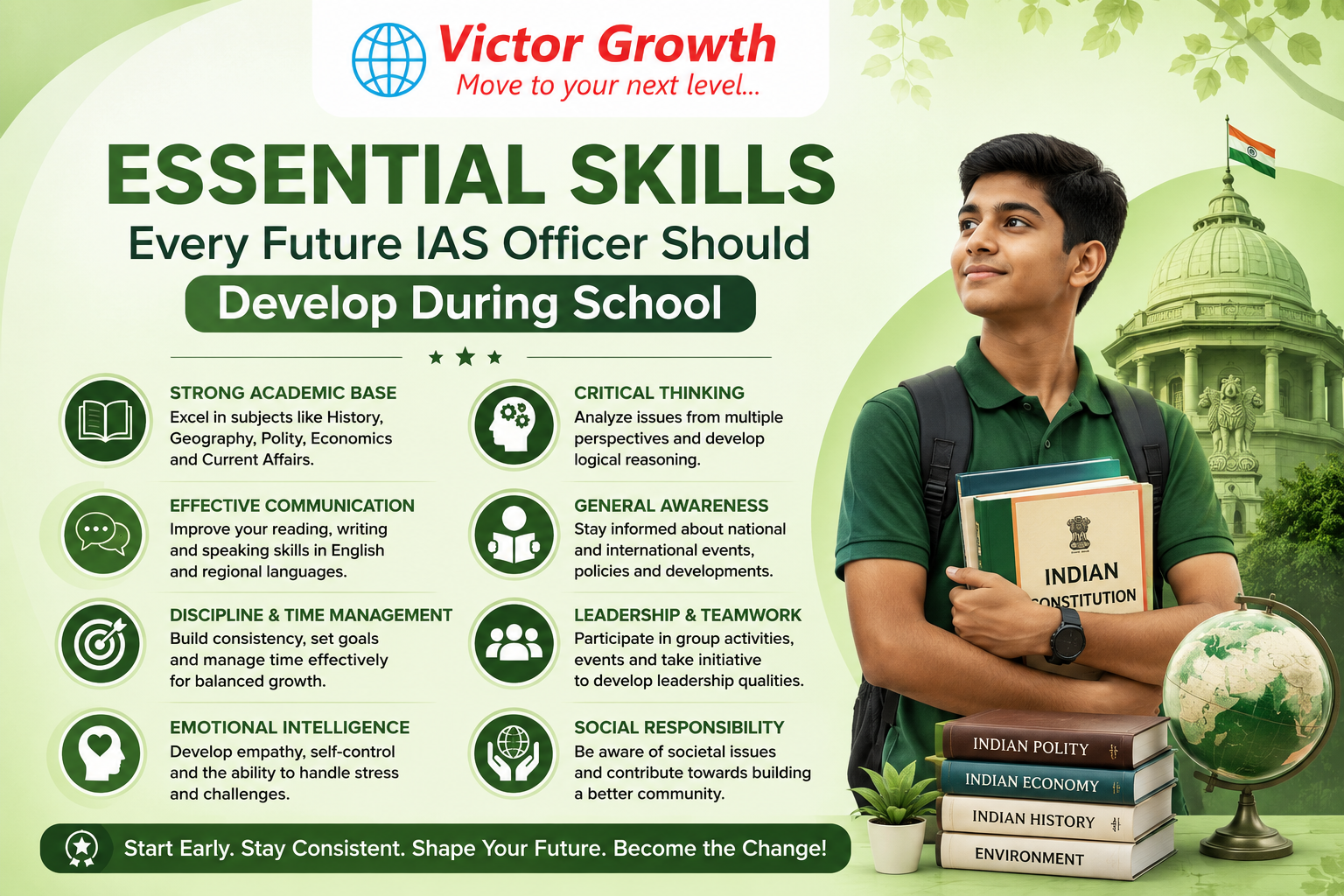
Becoming an Indian Administrative Service (IAS) officer is one of the most prestigious career aspirations in India. Every year, lakhs of candidates appear for the UPSC Civil Services Examination, but only a small percentage succeed. While knowledge of subjects such as History, Geography, Polity, Economics, and Current Affairs is important, the examination—and the role of an IAS officer—requires much more than academic excellence.
A successful IAS officer is expected to be an effective communicator, a thoughtful decision-maker, a compassionate leader, and a responsible public servant. These qualities are not developed in a few months of coaching; they are built gradually through years of learning and personal growth.
The school years provide the ideal opportunity to develop these essential skills. By nurturing curiosity, discipline, communication, leadership, and ethical values early in life, students prepare themselves not only for the UPSC examination but also for success in any profession.
For parents looking for the best IAS coaching in Kerala, a well-designed IAS Foundation Programme helps students acquire these skills while complementing their school education.
Why Skill Development Matters More Than Memorization
The UPSC examination has evolved significantly over the years. Modern question papers emphasize:
- Analytical thinking
- Problem-solving
- Ethical reasoning
- Decision-making
- Clear written communication
- Balanced opinions
- Awareness of national and international issues
An IAS officer is required to manage districts, implement government policies, coordinate with multiple departments, respond during emergencies, and make decisions that affect thousands of citizens.
Developing the right skills during school creates a strong foundation for these future responsibilities.
1. Reading Habit – The Foundation of Every IAS Aspirant
One of the most important habits every future IAS officer should develop is reading.
Students should gradually cultivate the habit of reading:
- Newspapers
- Children’s magazines
- Biographies of national leaders
- Science magazines
- History books
- Geography books
- General knowledge publications
- Quality non-fiction
Benefits of Reading
- Improves vocabulary
- Enhances comprehension
- Increases general awareness
- Strengthens writing skills
- Encourages curiosity
- Expands knowledge beyond textbooks
Students who develop consistent reading habits during school often find UPSC preparation significantly easier later.
2. Strong Communication Skills
IAS officers communicate with:
- Citizens
- Government officials
- Political representatives
- Media
- Experts
- International delegations
Students should therefore improve both written and spoken communication.
Ways to Improve Communication
- Participate in debates
- Deliver speeches
- Join group discussions
- Write essays
- Practice presentations
- Read aloud regularly
Clear communication builds confidence and improves academic performance.
3. Critical Thinking
Future civil servants must evaluate situations from multiple perspectives before making decisions.
Students should learn to ask:
- Why did this happen?
- What caused the problem?
- Who is affected?
- What are the possible solutions?
- What are the long-term consequences?
Critical thinking enables students to move beyond memorization and understand the deeper significance of issues.
4. Leadership Skills
Leadership is one of the defining qualities of an IAS officer.
During school, students should seek opportunities to:
- Lead group projects
- Organize events
- Participate in student councils
- Volunteer in community activities
- Coordinate team assignments
Leadership develops confidence, responsibility, and decision-making ability.
5. Time Management
Balancing school, extracurricular activities, hobbies, and personal interests teaches students valuable organizational skills.
Effective time management includes:
- Planning daily schedules
- Prioritizing tasks
- Avoiding procrastination
- Maintaining consistency
- Completing work on time
These habits become invaluable during higher education and competitive examination preparation.
6. Analytical Thinking
UPSC questions increasingly require students to analyze issues rather than recall facts.
Students should practice:
- Comparing viewpoints
- Interpreting graphs and maps
- Understanding cause-and-effect relationships
- Evaluating evidence
- Forming logical conclusions
Analytical thinking improves classroom performance and prepares students for future competitive examinations.
7. Curiosity and Lifelong Learning
Successful IAS officers remain lifelong learners.
Students should be encouraged to:
- Ask questions
- Explore new topics
- Visit museums and science centres
- Watch educational documentaries
- Read about innovations
- Participate in quizzes
Curiosity drives continuous learning and innovation.
8. Current Affairs Awareness
Understanding current events is essential for informed citizenship and future civil services preparation.
Students should gradually follow:
- National news
- International developments
- Science and technology
- Environment
- Economy
- Sports
- Government schemes
- Social issues
Current affairs should be understood through discussion and analysis rather than memorization.
9. Ethical Values and Integrity
Integrity is one of the most important qualities of an IAS officer.
Schools and families should encourage students to practice:
- Honesty
- Responsibility
- Respect
- Fairness
- Empathy
- Accountability
- Compassion
Ethical decision-making becomes stronger through consistent practice in everyday situations.
10. Emotional Intelligence
Civil servants frequently deal with people from different backgrounds and must remain calm during challenging situations.
Students should develop:
- Self-awareness
- Emotional control
- Empathy
- Active listening
- Respect for diversity
- Conflict resolution skills
Emotional intelligence strengthens leadership and teamwork.
11. Writing Skills
The UPSC Mains Examination evaluates the ability to present ideas clearly and logically.
School students can prepare by practicing:
- Essay writing
- Report writing
- Creative writing
- Opinion-based answers
- Structured note-making
Writing regularly improves clarity of thought and organization.
12. Public Speaking
Fear of speaking in public can limit future opportunities.
Students should participate in:
- Debates
- Speeches
- Elocution competitions
- Presentations
- Storytelling contests
Public speaking builds confidence and improves communication.
13. Problem-Solving Ability
Every IAS officer encounters complex administrative challenges.
Students should learn systematic problem-solving by:
- Identifying the issue
- Gathering information
- Considering alternatives
- Evaluating consequences
- Choosing practical solutions
These skills can be developed through projects, case studies, and collaborative activities.
14. Teamwork and Collaboration
Administration requires cooperation with multiple departments and stakeholders.
Students should actively participate in:
- Team projects
- Sports
- Cultural activities
- Science exhibitions
- Community programmes
Working with others improves communication, leadership, and adaptability.
15. Decision-Making Skills
Good decisions require balanced judgment.
Students can improve decision-making by:
- Evaluating different viewpoints
- Considering ethical principles
- Assessing risks
- Thinking logically before acting
Regular exposure to discussions and case studies strengthens this ability.
16. Digital Literacy
Modern governance increasingly relies on technology.
Students should become comfortable using:
- Educational software
- Online research tools
- Digital presentations
- Word processing
- Spreadsheets
- Responsible internet practices
Digital literacy supports both academic learning and future administrative responsibilities.
17. Social Awareness
Future administrators must understand society.
Students should learn about:
- Rural development
- Urban issues
- Education
- Healthcare
- Environment
- Poverty
- Women’s empowerment
- Inclusive development
Social awareness develops empathy and responsible leadership.
18. Discipline and Consistency
Long-term success depends more on consistency than occasional bursts of effort.
Students should develop habits such as:
- Daily reading
- Regular revision
- Physical exercise
- Healthy routines
- Goal setting
Discipline creates a strong foundation for lifelong achievement.
Role of Parents in Skill Development
Parents can help children develop these skills by:
- Encouraging reading every day
- Discussing current affairs during family conversations
- Supporting participation in debates, quizzes, and competitions
- Promoting independent thinking
- Appreciating effort rather than only marks
- Maintaining a healthy balance between academics, sports, hobbies, and rest
A supportive environment fosters confidence and lifelong curiosity.
How an IAS Foundation Programme Helps
A structured IAS Foundation Programme integrates these skills through carefully designed learning experiences.
Students benefit from:
- Concept-based learning
- Current affairs discussions
- Public speaking practice
- Leadership activities
- Essay writing sessions
- Group discussions
- Personality development workshops
- Mentorship
- Regular assessments
- Interactive classroom participation
Rather than adding unnecessary academic pressure, the programme complements school education and nurtures holistic development.
Why Choose the Best IAS Coaching in Kerala?
The best IAS coaching in Kerala provides more than examination guidance. A quality foundation programme offers:
- Experienced UPSC mentors
- Age-appropriate curriculum
- Interactive teaching methods
- Leadership and personality development
- Communication skills training
- Current affairs integration
- Ethical and civic education
- Individual mentorship
- Continuous feedback
- A balanced approach that supports school academics
Such programmes prepare students not only for future competitive examinations but also for becoming confident, responsible, and capable leaders.
Conclusion
The journey to becoming an IAS officer begins long before the UPSC examination. It starts during the school years, when students develop the habits, values, and skills that shape their future.
Reading, communication, leadership, analytical thinking, ethics, emotional intelligence, and discipline are not only essential for civil servants—they are qualities that contribute to success in every field.
For families searching for the best IAS coaching in Kerala, enrolling students in a structured IAS Foundation Programme can provide the guidance and opportunities needed to build these essential competencies. Even if a student ultimately chooses a different career, the skills gained will remain valuable throughout life.
The future of public service is built one habit, one skill, and one responsible decision at a time.
Frequently Asked Questions (FAQs)
1. What are the most important skills every future IAS officer should develop during school?
Students should focus on developing:
- Reading habits
- Communication skills
- Leadership
- Critical thinking
- Analytical ability
- Time management
- Ethical values
- Emotional intelligence
- Current affairs awareness
- Writing skills
2. Why is reading considered so important for IAS preparation?
Reading improves vocabulary, comprehension, general awareness, analytical thinking, and writing ability. It also helps students understand society, governance, and current events more effectively.
3. How can school students improve their communication skills?
Students can participate in debates, public speaking, group discussions, essay competitions, presentations, and regular reading to improve both written and spoken communication.
4. Does an IAS Foundation Programme help students who do not plan to become IAS officers?
Yes. The programme develops transferable skills such as leadership, communication, critical thinking, discipline, and problem-solving that are valuable in engineering, medicine, law, management, entrepreneurship, research, and many other careers.
5. At what age should students start developing these skills?
Many educators recommend beginning from Classes 6 to 8, with structured IAS Foundation Programmes often being most suitable from Classes 8 to 12, depending on the student’s maturity and interest.
6. How can parents support their child’s development?
Parents can encourage daily reading, discuss current affairs, promote independent thinking, support extracurricular participation, maintain a balanced lifestyle, and appreciate consistent effort instead of focusing only on examination marks.
7. Why should parents choose the best IAS coaching in Kerala?
The best IAS coaching in Kerala provides experienced faculty, structured foundation programmes, communication and leadership training, personality development, current affairs integration, and individual mentorship that support both school education and long-term career growth.
8. Are these skills useful beyond the UPSC examination?
Absolutely. Leadership, communication, ethics, critical thinking, digital literacy, teamwork, and emotional intelligence are essential for success in almost every profession, including engineering, medicine, law, business, research, public policy, and entrepreneurship.