One of the most common habits shared by successful IAS officers is reading newspapers every day. Whether it is an IAS topper, a senior civil servant, or an experienced UPSC mentor, almost everyone emphasizes that newspaper reading is an essential part of the preparation journey.
However, many parents wonder:
“Should school students start reading newspapers so early?”
The answer is yes—but in the right way.
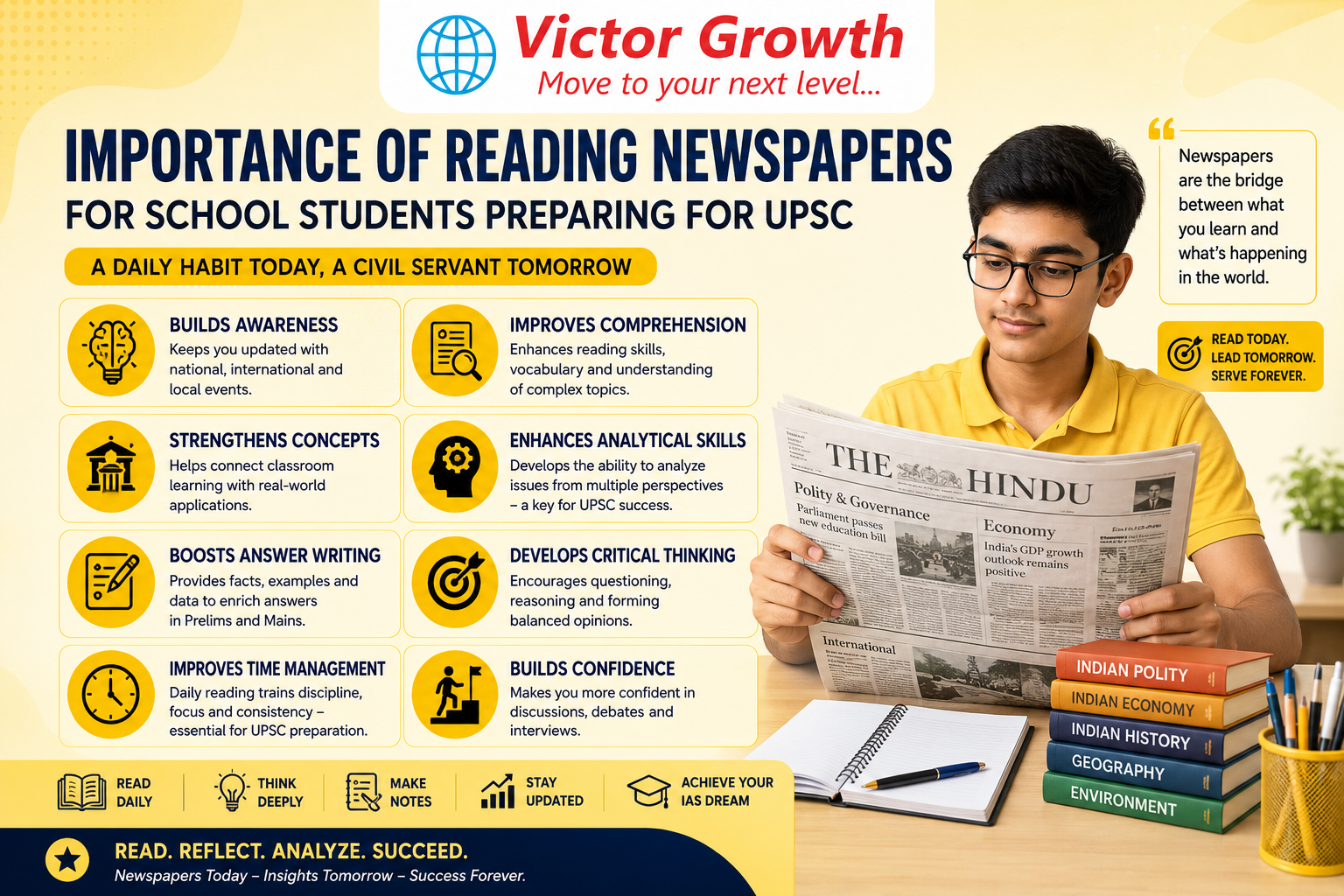
Reading newspapers during school is not about memorizing current affairs or preparing directly for the UPSC examination. It is about developing awareness, curiosity, communication skills, analytical thinking, and a lifelong habit of learning.
For students from Classes 6 to 12, newspaper reading gradually builds the intellectual foundation required for future competitive examinations while also improving school performance.
For families searching for the best IAS coaching in Kerala, newspaper reading is considered one of the most effective and affordable learning tools that complements an IAS Foundation Programme.
Why Newspaper Reading Is Important
A newspaper is much more than a source of daily news.
It introduces students to:
- National events
- International affairs
- Science and technology
- Economy
- Environment
- Government policies
- Sports
- Culture
- Social issues
Every article helps students understand how the world functions beyond classroom textbooks.
Unlike textbooks, newspapers connect academic knowledge with real-life situations.
Why School Students Should Start Early
Many students begin reading newspapers only after graduation when they start UPSC preparation.
While this is possible, students who begin during school enjoy several long-term advantages.
They gradually develop:
- Reading speed
- Better comprehension
- Vocabulary
- General awareness
- Curiosity
- Confidence
Most importantly, newspaper reading becomes a natural daily habit rather than an additional task.
1. Improves General Knowledge
General knowledge cannot be developed overnight.
Daily newspapers expose students to information about:
- India
- The world
- Science
- Technology
- Geography
- Economy
- Government
- Sports
- Awards
- Environment
Over several years, this creates a strong knowledge base that benefits school examinations, quizzes, Olympiads, scholarship tests, and future competitive examinations.
2. Builds Current Affairs Awareness
Current affairs form an important part of the UPSC Civil Services Examination.
School students should gradually become familiar with topics such as:
- Parliament
- Supreme Court judgments
- Government schemes
- Elections
- International relations
- Climate change
- Scientific discoveries
- Economic developments
The focus should be on understanding events rather than memorizing facts.
3. Enhances Vocabulary
Reading newspapers introduces students to thousands of new words over time.
Students naturally improve:
- Vocabulary
- Grammar
- Sentence construction
- Language comprehension
This helps in:
- School examinations
- Essay writing
- Public speaking
- Competitive examinations
4. Improves Reading Speed
The UPSC examination requires candidates to process large volumes of information efficiently.
Students who begin reading newspapers early gradually develop:
- Faster reading
- Better comprehension
- Improved concentration
- Higher retention
These skills benefit all academic subjects.
5. Strengthens Analytical Thinking
Modern education values analysis over memorization.
Newspaper reading encourages students to ask:
- Why did this happen?
- What caused this issue?
- Who is affected?
- What are the possible solutions?
- What will happen in the future?
This habit develops critical thinking and problem-solving abilities.
6. Connects School Subjects with Real Life
Many students wonder why they study subjects like Geography, History, Economics, and Political Science.
Newspapers provide real-life examples.
For example:
Geography
- Floods
- Earthquakes
- Climate change
- Cyclones
Economics
- Inflation
- Budget
- Employment
- Banking
Political Science
- Elections
- Parliament
- Judiciary
- Government policies
Science
- Space missions
- Artificial Intelligence
- Medical discoveries
- Renewable energy
Learning becomes more meaningful when students see classroom concepts in everyday life.
7. Improves Writing Skills
Good writing begins with good reading.
Students who read newspapers regularly often develop better:
- Essay writing
- Report writing
- Creative writing
- Grammar
- Sentence structure
- Presentation of ideas
Exposure to quality journalism helps students organize their thoughts more effectively.
8. Enhances Communication Skills
Reading newspapers provides students with ideas, facts, and opinions that improve communication.
Students become more confident during:
- Classroom discussions
- Debates
- Presentations
- Interviews
- Group discussions
They learn to express informed opinions instead of repeating memorized information.
9. Encourages Curiosity
Every newspaper article introduces new questions.
Students become curious about:
- Countries
- Scientific discoveries
- Government decisions
- Historical events
- Environmental challenges
- Social issues
Curiosity is one of the strongest qualities of successful civil servants.
10. Develops Decision-Making Ability
IAS officers regularly make important decisions.
Newspapers expose students to:
- Public policy
- Administrative challenges
- Ethical dilemmas
- Social issues
By analyzing these situations, students gradually develop balanced judgment.
11. Improves Performance in School
Parents often notice improvement in:
- Social Science
- English
- General Science
- Essay writing
- Reading comprehension
- Projects
- Quiz competitions
Students also become more active participants in classroom discussions.
12. Builds Confidence
Knowledge creates confidence.
Students who regularly read newspapers can:
- Speak confidently
- Participate in competitions
- Answer unexpected questions
- Share informed opinions
Confidence grows naturally through consistent learning.
13. Helps in Competitive Examinations
Newspaper reading supports preparation for:
- UPSC Civil Services
- Kerala Administrative Service (KAS)
- NDA
- CDS
- CLAT
- CUET
- SSC
- Banking examinations
- Scholarship tests
- Olympiads
Current affairs and analytical thinking are valuable across multiple examinations.
14. Creates Responsible Citizens
Future civil servants should understand society.
Newspapers expose students to:
- Social justice
- Healthcare
- Education
- Rural development
- Women’s empowerment
- Environmental conservation
- Constitutional values
This broadens perspectives and encourages responsible citizenship.
What Should School Students Read?
Students do not need to read every page of a newspaper.
They should focus on:
National News
Government initiatives, Parliament, important policies, and significant national developments.
International News
Major global events, international organizations, diplomacy, and global issues.
Science and Technology
Space missions, innovations, Artificial Intelligence, biotechnology, and medical research.
Environment
Climate change, biodiversity, wildlife conservation, renewable energy, and sustainability.
Economy
Simple explanations of the Budget, inflation, banking, employment, entrepreneurship, and economic growth.
Editorials
Older students (Classes 10–12) can begin reading selected editorials to understand balanced opinions and improve analytical thinking.
Sports
Major national and international sporting events, especially achievements that shape public life and inspire leadership.
What Can Students Skip?
Students preparing for UPSC foundation generally do not need to spend much time on:
- Celebrity gossip
- Entertainment news
- Crime stories without larger public significance
- Sensational headlines
- Commercial advertisements
The aim is to focus on informative and educational content.
How Much Time Should Students Spend?
Suggested daily reading time:
| Class | Recommended Time |
|---|---|
| Classes 6–8 | 15–20 minutes |
| Classes 9–10 | 20–30 minutes |
| Classes 11–12 | 30–45 minutes |
The emphasis should remain on understanding rather than finishing the entire newspaper.
How Parents Can Encourage Newspaper Reading
Parents play an important role by:
- Reading newspapers together with younger children
- Discussing important news during meals
- Encouraging questions
- Explaining difficult terms
- Appreciating curiosity
- Limiting unnecessary screen time
- Creating a daily reading routine
Making newspaper reading enjoyable is more effective than making it compulsory.
Role of an IAS Foundation Programme
A structured IAS Foundation Programme teaches students how to read newspapers effectively.
Students learn to:
- Identify important news
- Understand government policies
- Analyze current affairs
- Connect news with school subjects
- Improve note-making
- Discuss national and international issues
This guided approach makes newspaper reading meaningful and productive.
Why Choose the Best IAS Coaching in Kerala?
The best IAS coaching in Kerala understands that successful UPSC preparation begins with strong habits rather than rushed coaching.
A quality foundation programme provides:
- Newspaper analysis sessions
- Current affairs discussions
- Reading comprehension exercises
- Vocabulary development
- Communication skills training
- Essay writing practice
- Leadership activities
- Experienced mentorship
- Age-appropriate learning methods
- Individual guidance
These programmes help students become informed learners while improving school performance and preparing them for future competitive examinations.
Conclusion
Reading newspapers is one of the simplest yet most powerful habits a school student can develop. It strengthens vocabulary, communication, current affairs awareness, analytical thinking, writing skills, and general knowledge while connecting classroom learning with the real world.
Students who begin reading newspapers during school gradually build the intellectual curiosity and awareness expected of future civil servants. More importantly, they become better learners, better communicators, and more responsible citizens.
For parents seeking the best IAS coaching in Kerala, choosing an IAS Foundation Programme that emphasizes newspaper reading and current affairs analysis can provide students with a lasting academic advantage. Rather than treating newspapers as exam material, students should see them as a daily source of knowledge, inspiration, and lifelong learning.
Frequently Asked Questions (FAQs)
1. Why should school students read newspapers for UPSC preparation?
Newspapers help students build current affairs awareness, vocabulary, reading comprehension, analytical thinking, communication skills, and general knowledge. These skills are valuable for school education and future competitive examinations.
2. At what age should students start reading newspapers?
Students can begin with age-appropriate news from Classes 6 to 8. By Classes 9 to 12, they can gradually read more detailed national, international, science, and editorial content with guidance.
3. Which sections of the newspaper are most important?
Students should focus on:
- National news
- International news
- Science and Technology
- Environment
- Economy
- Government policies
- Selected editorials
- Educational features
4. Should students read the entire newspaper every day?
No. Reading the most relevant sections carefully and understanding the content is more beneficial than trying to finish every page.
5. How much time should school students spend reading newspapers?
Generally:
- Classes 6–8: 15–20 minutes daily
- Classes 9–10: 20–30 minutes daily
- Classes 11–12: 30–45 minutes daily
Consistency is more important than duration.
6. Does newspaper reading improve school performance?
Yes. Regular newspaper reading enhances vocabulary, comprehension, writing skills, critical thinking, and awareness, helping students perform better in English, Social Science, General Science, projects, presentations, and quizzes.
7. How does the best IAS coaching in Kerala help students with newspaper reading?
The best IAS coaching in Kerala provides structured guidance through newspaper analysis sessions, current affairs discussions, vocabulary building, note-making techniques, and mentorship that helps students understand and apply what they read.
8. Can newspaper reading alone prepare students for UPSC?
No. Newspaper reading is one important component of a strong foundation. It should be combined with school education, NCERT learning, conceptual understanding, communication skills, leadership development, and a structured IAS Foundation Programme for comprehensive preparation.