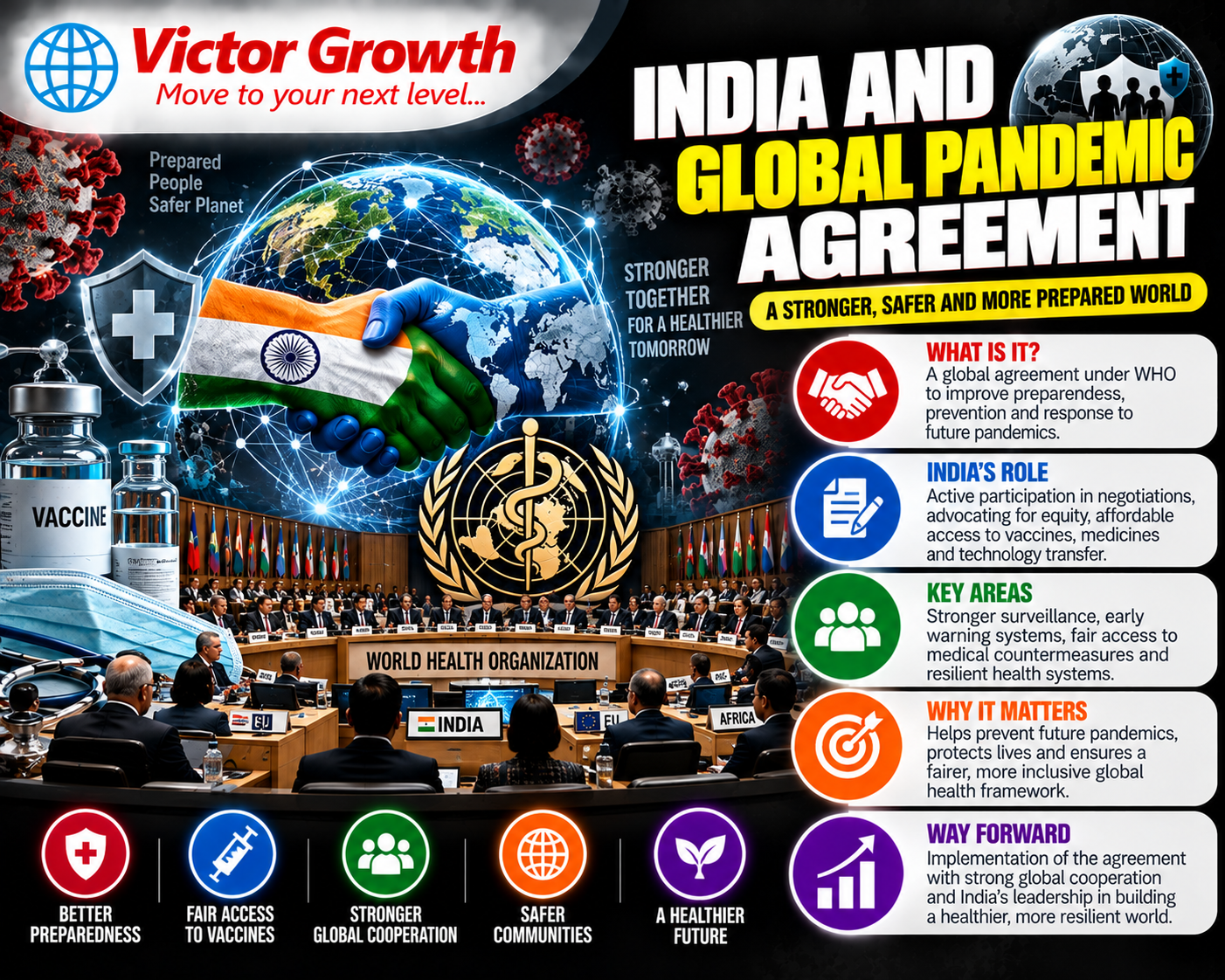
India has reaffirmed its commitment to strengthening global pandemic preparedness and response, while stressing the importance of equity, national sovereignty and fair access to health technologies under the WHO Pandemic Agreement.
The issue has gained renewed importance as negotiations continue on the Pathogen Access and Benefit-Sharing (PABS) system, a crucial component of the agreement. India has called for a fair system under which countries sharing pathogens and biological resources also receive timely access to vaccines, diagnostics, therapeutics and technologies developed from them.
What is the WHO Pandemic Agreement?
The WHO Pandemic Agreement is the world’s first international legally binding agreement specifically designed to strengthen global cooperation on pandemic prevention, preparedness and response.
It was adopted by consensus at the 78th World Health Assembly on 20 May 2025, following more than three years of negotiations initiated after the COVID-19 pandemic exposed major weaknesses and inequalities in the global health system.
The agreement seeks to strengthen:
Pandemic surveillance and early warning systems
Health-system preparedness
Research and development
Vaccine, diagnostic and therapeutic access
Local manufacturing capacity
Technology transfer
Health workforce capacity
International cooperation
Sustainable pandemic financing
India’s Position
India has broadly supported stronger international cooperation against pandemics but emphasises that global health governance must be equitable and respectful of national sovereignty.
At the UN High-Level Meeting on Pandemic Prevention, Preparedness and Response in September 2026, India highlighted the need for a fair PABS mechanism. India argued that countries contributing pathogens and biological resources should receive appropriate benefits, including access to vaccines, diagnostics and therapeutics.
India has also highlighted its contribution during COVID-19. It supplied around 300 million vaccine doses to about 100 countries and provided medical assistance to more than 150 countries.
What is Pathogen Access and Benefit-Sharing (PABS)?
PABS is one of the most important and contentious elements of the Pandemic Agreement.
The basic principle is:
Sharing of pathogen materials and genetic information → scientific research and product development → equitable sharing of resulting benefits.
Countries need rapid access to pathogens and genetic sequence information to develop vaccines, diagnostics and treatments. At the same time, countries providing biological resources expect fair access to the benefits arising from their use.
The WHO negotiations aim to establish a framework that balances these interests.
Why is the Agreement Important for India?
1. Protection against Future Pandemics
India’s large population and extensive international connectivity make pandemic preparedness a major public-health priority.
2. Vaccine and Pharmaceutical Capacity
India is a major producer of vaccines and medicines. A predictable global framework can help strengthen supply chains while ensuring equitable access.
3. Global South Concerns
India has consistently highlighted the concerns of developing countries regarding unequal access to vaccines, medicines, technology and health resources.
4. Strengthening Health Security
Pandemic preparedness requires cooperation across health, biotechnology, animal health, environment and other sectors. This supports the One Health approach.
Pandemic Agreement and National Sovereignty
An important point for UPSC aspirants is that the agreement does not give WHO authority to impose domestic lockdowns, vaccination mandates or travel restrictions on countries.
The agreement explicitly recognises national sovereignty. Implementation remains subject to the constitutional and domestic processes of individual countries.
Current Status
Although the Pandemic Agreement was adopted in May 2025, its implementation process is still evolving.
The PABS annex remains crucial. In 2026, WHO Member States agreed to continue negotiations on this annex, with further work extending towards 2027 if necessary. The agreement will become operational only after the required procedural steps, including adoption of the PABS annex and ratification by at least 60 countries.
Challenges
Major challenges include:
Equitable access to vaccines and medicines
Technology transfer and intellectual-property concerns
Sharing of pathogen materials and genetic sequence data
Financing pandemic preparedness
Balancing national sovereignty with global coordination
Ensuring participation of developing countries in decision-making
Building resilient global supply chains
UPSC Relevance
Prelims
Important facts:
WHO Pandemic Agreement adopted: 20 May 2025
Adopted by: 78th World Health Assembly
Legal basis: Article 19 of the WHO Constitution
Key unresolved component: Pathogen Access and Benefit-Sharing (PABS)
Entry into force: After the required PABS process and 60 ratifications
Key principles: Equity, solidarity, cooperation and national sovereignty
Related framework: International Health Regulations (2005)
Mains – GS Paper II
The topic is relevant to:
Global health governance
International institutions
India’s role in multilateral organisations
Global South
Health diplomacy
International cooperation
Mains – GS Paper III
It is also relevant to:
Biotechnology
Public health
Pharmaceutical industry
Pandemic preparedness
Health infrastructure
Intellectual property rights
Possible UPSC Mains Question
“The WHO Pandemic Agreement seeks to strengthen global pandemic preparedness, but its success will depend on equity, technology sharing and respect for national sovereignty. Discuss India’s concerns and interests in this framework.”
Conclusion
The WHO Pandemic Agreement represents an important attempt to learn from the COVID-19 experience and strengthen global health security. For India, the central priorities are equity, access to health technologies, fair benefit-sharing and respect for national sovereignty.
The ongoing negotiations on the PABS mechanism will be crucial in determining whether the agreement can translate global solidarity into practical and equitable pandemic preparedness.