
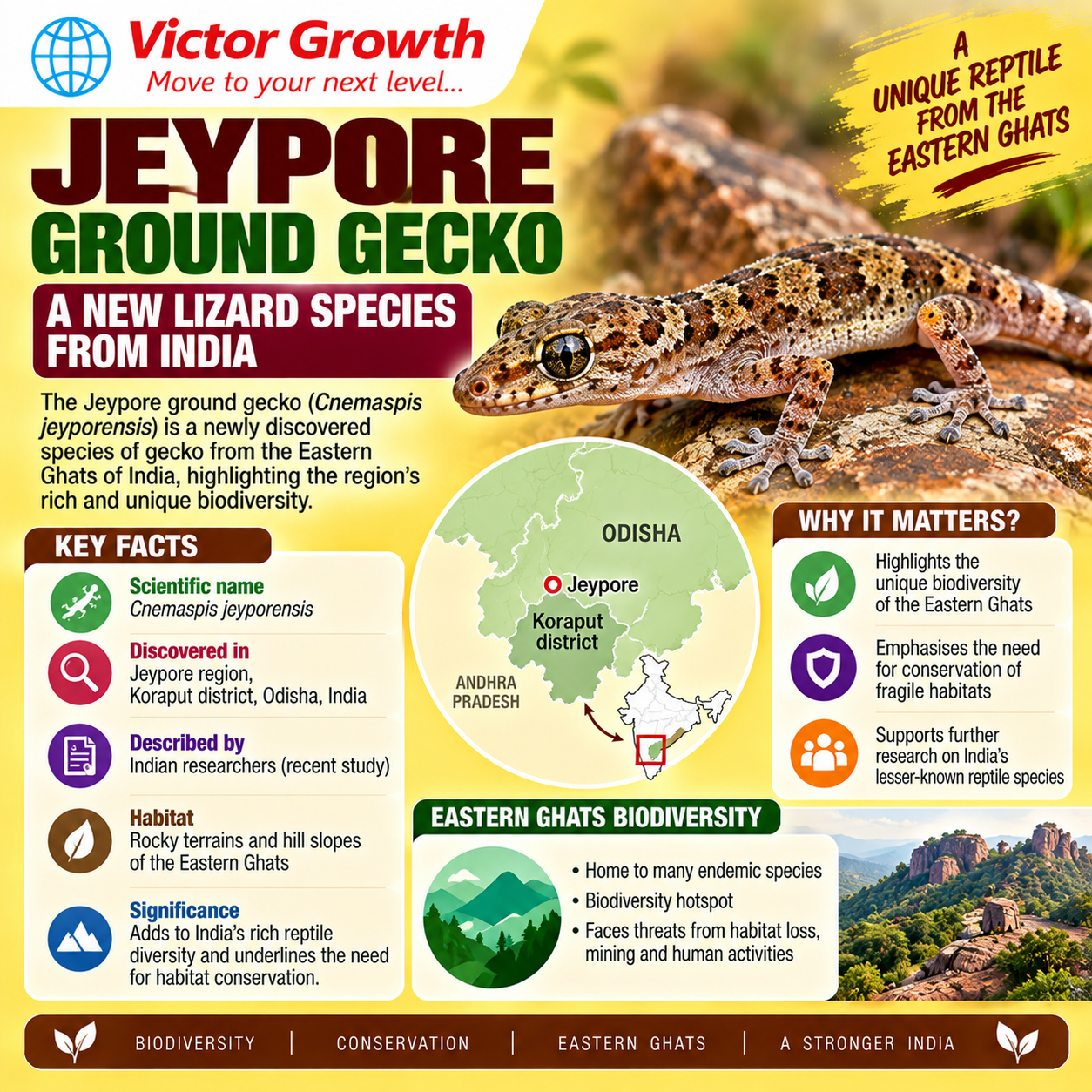
The endangered Jeypore Ground Gecko has come into focus following concerns that a proposed open-cast bauxite mining project in the Balda Hills of Odisha could threaten its fragile habitat. The project area lies within the Nageswari Reserve Forest in Koraput district, highlighting the challenge of balancing mineral development with biodiversity conservation. <Cite refs={[“turn536476search7″,”turn536476search11”]}/>
What Is the Jeypore Ground Gecko?
Scientific name: Cyrtodactylus jeyporensis (also known in older classifications as Geckoella jeyporensis).
Type: A small, nocturnal, ground-dwelling reptile.
Discovery: First documented in the late 19th century by naturalist Richard Henry Beddome; rediscovered in 2010 after more than a century without confirmed records.
Distribution: Restricted to parts of the Eastern Ghats in southern Odisha and northern Andhra Pradesh.
Habitat: Moist, high-elevation forests, rocky outcrops, boulder crevices and forest-floor leaf litter, generally around 900–1,400 metres.
IUCN Red List: Endangered.
CITES: Included in Appendix II in 2022, which regulates international trade to help prevent trade from threatening the species’ survival. <Cite refs={[“turn536476search2″,”turn536476search9″,”turn536476search12”]}/>
Its highly restricted distribution makes it vulnerable to even small-scale habitat destruction.
Why Is the Species Under Threat?
1. Bauxite mining
The proposed mining project in the Balda Hills could remove forest cover and disturb the rocky microhabitats on which the gecko depends. Its original recorded locality near Potangi has reportedly suffered habitat loss associated with mining. <Cite refs={[“turn536476search7″,”turn536476search10”]}/>
2. Habitat fragmentation
Deforestation, plantations, mining and forest fires can divide its limited habitat into isolated patches, affecting survival and reproduction.
3. Limited scientific knowledge
Its population size, behaviour and life cycle remain poorly understood. This makes long-term monitoring and evidence-based conservation especially important.
4. Impact on tribal communities
The Balda Hills landscape is also important to local Adivasi communities. The dispute therefore involves biodiversity, traditional livelihoods, cultural values and forest rights.
Balancing Development and Conservation
The issue highlights the need for:
Scientific environmental impact assessments: Evaluate impacts on rare and endemic species before approving projects.
Habitat protection: Identify critical habitats and avoid mining in ecologically irreplaceable areas.
Community participation: Recognise applicable forest rights and consult affected communities meaningfully.
Long-term monitoring: Conduct systematic surveys and establish population and habitat baselines.
Sustainable mineral planning: Explore alternatives that reduce ecological damage while meeting development needs.