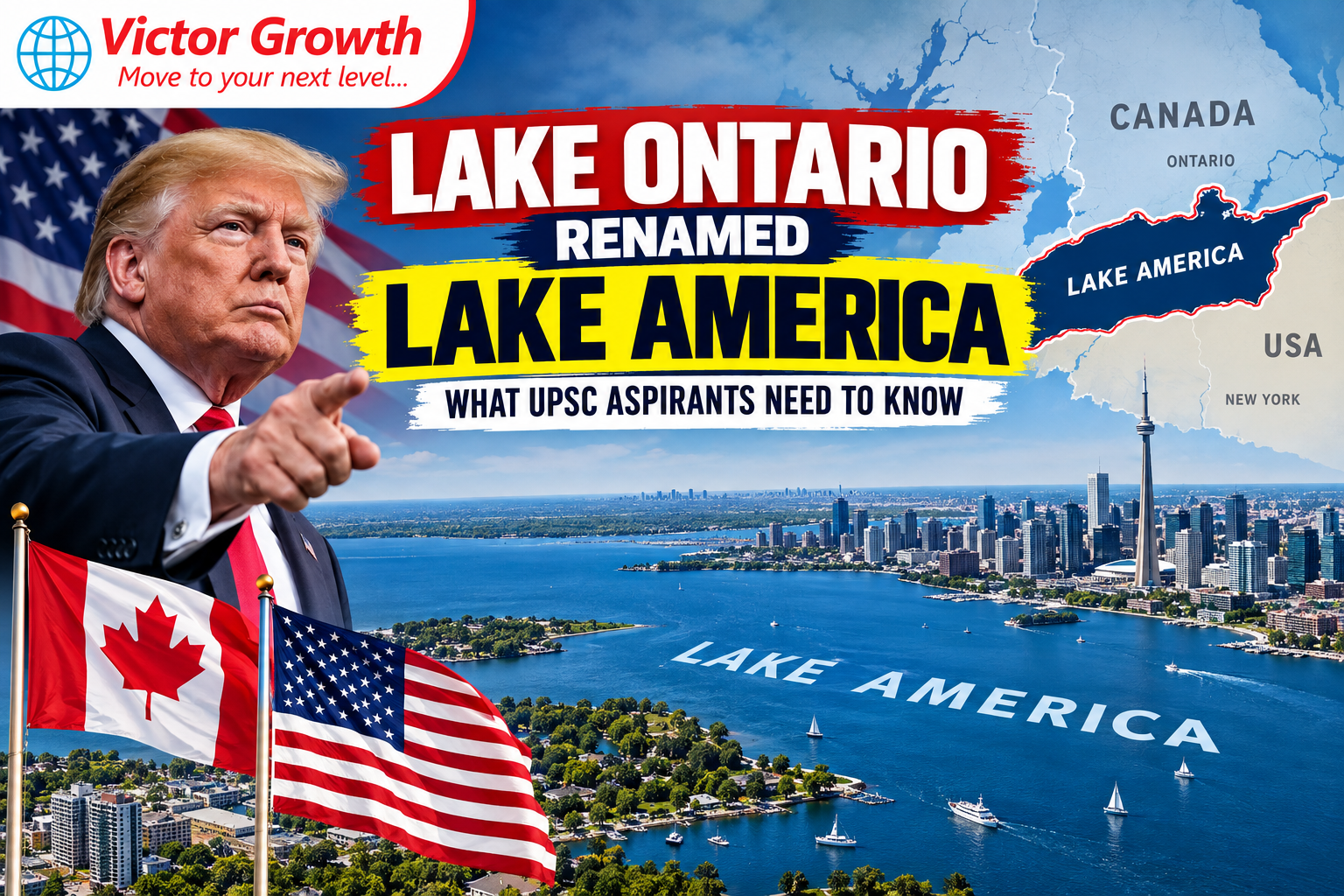
The United States has officially changed the name of Lake Ontario to “Lake America” for U.S. federal purposes, following an executive order signed by President Donald Trump on 27 August 2026. The U.S. Geographic Names Information System (GNIS) was subsequently updated.
However, Canada continues to use the name Lake Ontario. Google Maps has adopted the U.S. name for users in the United States, while Canadian users continue to see “Lake Ontario”; users elsewhere can see both names.
For UPSC aspirants, the issue is important not simply because of the name change, but because it connects physical geography, international boundaries, freshwater resources, trade, and US–Canada relations.
1. Where Is Lake Ontario?
Lake Ontario is one of the five Great Lakes of North America.
It lies between:
United States 🇺🇸 – New York State
and
Canada 🇨🇦 – Province of Ontario
The lake is connected to the Atlantic Ocean through the St. Lawrence River and the St. Lawrence Seaway.
Remember the Great Lakes:
Superior → Michigan → Huron → Erie → Ontario
A useful mnemonic:
“Super Man Helps Every One”
2. Why Is Lake Ontario Important?
Lake Ontario is important for:
Freshwater resources
Drinking water
Shipping and transportation
Agriculture
Industry
Hydropower
Tourism and recreation
The Great Lakes–St. Lawrence Seaway system
The Great Lakes together form one of the world’s largest freshwater systems.
The U.S. executive order itself highlights the lake’s importance to shipping, industry, agriculture, energy and freshwater supply.
3. Why Was It Renamed?
The U.S. executive order directed federal agencies to replace “Lake Ontario” with “Lake America” in U.S. federal records and geographic databases.
The order presents the lake as an important American economic, historical and strategic resource.
However, the change applies to U.S. governmental usage. It does not automatically compel Canada or other countries to adopt the new name.
4. Why Is This Geographically Interesting?
Lake Ontario is a transboundary water body.
This means it is shared by two countries.
Therefore, the case demonstrates an important geographical principle:
A geographic feature can have different official names in different countries.
This is particularly relevant for UPSC because international geography often involves shared rivers, lakes, seas and mountain regions.
5. The Great Lakes: A UPSC Favourite
The five Great Lakes are:
| Great Lake | Important Fact |
|---|---|
| Superior | Largest by surface area |
| Michigan | Entirely within the USA |
| Huron | Shared by USA & Canada |
| Erie | Shared by USA & Canada |
| Ontario | Shared by USA & Canada |
Important fact:
Lake Michigan is the only Great Lake located entirely within the United States.
The other four are shared by the United States and Canada.
6. Why Does the Great Lakes Region Matter?
The Great Lakes are important for:
Freshwater
They contain a major share of the world’s surface freshwater.
Trade
The Great Lakes–St. Lawrence Seaway provides a maritime connection between the North American interior and the Atlantic Ocean.
Industry
The region has historically supported:
Steel
Manufacturing
Agriculture
Mining
Energy
Environment
The lakes face challenges such as:
Pollution
Invasive species
Climate change
Water-quality concerns
7. US–Canada Relations
The renaming has also attracted attention because the lake is shared by the United States and Canada.
Canada has continued to use the traditional name Lake Ontario. Canadian officials have pointed to the name’s long historical and Indigenous origins.
This illustrates an important UPSC concept:
Geographical naming can sometimes become connected with diplomacy, identity and international relations.
8. Why Is This Relevant to India?
At first glance, Lake Ontario may appear unrelated to India.
But UPSC preparation requires connecting geography with broader concepts.
This topic can be linked to:
Transboundary water resources
International water governance
Freshwater security
Maritime trade
Geographic naming
International relations
Environmental management
India itself has several important transboundary rivers, including:
Indus
Ganga
Brahmaputra
Teesta
Therefore, the Lake Ontario issue provides a useful comparative example for understanding shared natural resources between countries.
9. Prelims Map Points to Remember
Locate these on a map:
North America → Canada → United States → Great Lakes → Lake Ontario → New York → St. Lawrence River → Atlantic Ocean
Also remember:
Great Lakes → St. Lawrence River → St. Lawrence Seaway → Atlantic Ocean
UPSC Prelims Quick Question
Consider the following statements:
Lake Ontario is one of the Great Lakes of North America.
Lake Ontario is shared by the United States and Canada.
The Great Lakes are connected to the Atlantic Ocean through the St. Lawrence system.
Lake Michigan is shared by the United States and Canada.
Which of the above statements are correct?
Answer: 1, 2 and 3 only.
UPSC Mains Connection
Possible GS Paper 1 Question
“Transboundary geographical features often acquire geopolitical significance.” Discuss with suitable examples.
Possible GS Paper 2 Question
Discuss the importance of cooperation between countries in managing shared freshwater resources.
Key Takeaways
Remember these 7 points:
1. Lake Ontario is one of the five Great Lakes.
2. It lies between New York (USA) and Ontario (Canada).
3. The United States has officially adopted “Lake America” for U.S. federal usage.
4. Canada continues to call it Lake Ontario.
5. The lake is connected to the Atlantic Ocean through the St. Lawrence system.
6. The Great Lakes are important for freshwater, trade, industry and ecology.
7. For UPSC, connect the issue with transboundary water resources + geography + international relations.
UPSC Memory Formula
LAKE ONTARIO → GREAT LAKES → US–CANADA → FRESHWATER → ST. LAWRENCE → TRADE → TRANSBOUNDARY GEOGRAPHY
Don’t just remember the new name. Understand the geography behind the news.