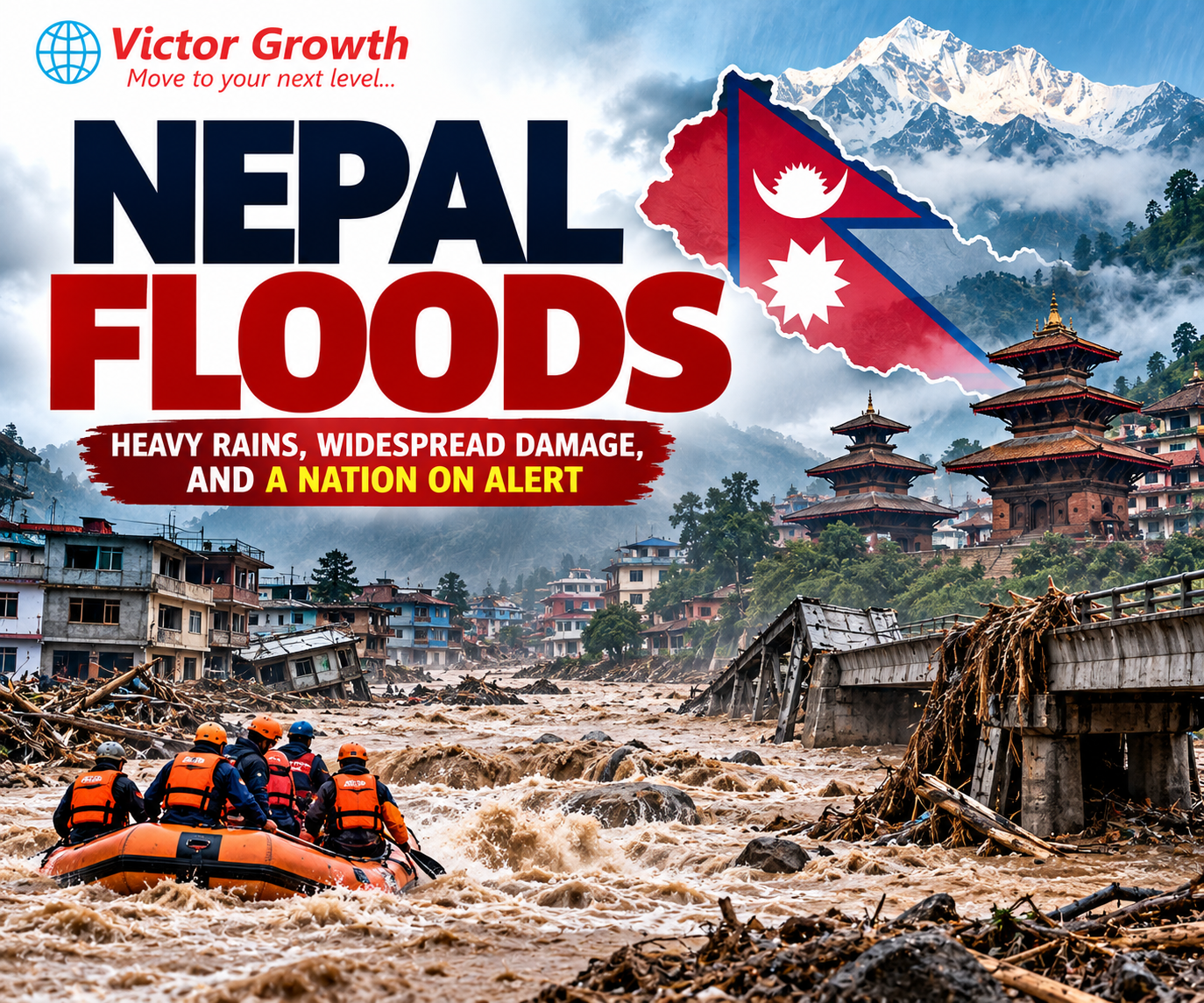
The devastating floods and landslides in Nepal in 2026 have highlighted the vulnerability of the Himalayan region to extreme weather events, glacial hazards and fragile mountain ecosystems. For UPSC aspirants, the disaster is important from the perspectives of geography, disaster management, climate change, India–Nepal relations and transboundary river management.
What Happened in Nepal?
On 26 August 2026, a severe flood event affected the Bhote Koshi–Trishuli river system, causing extensive destruction in parts of Nepal. The disaster damaged houses, roads, bridges and hydropower infrastructure, particularly in districts including Rasuwa, Nuwakot and Dhading. Nepal’s authorities subsequently undertook large-scale search, rescue and relief operations.
India’s National Disaster Response Force (NDRF) reported that a sudden rise in the Trishuli River was suspected to be associated with glacial lake outburst flood (GLOF) activity near the Nepal–China border. The flood wave was expected to travel downstream through the Gandak river system, prompting heightened alert in parts of Bihar and Uttar Pradesh.
Why Are Himalayan Regions Vulnerable to Floods?
Nepal’s mountainous terrain creates several natural vulnerabilities:
1. Intense Rainfall
The South Asian monsoon can produce extremely heavy rainfall over short periods, increasing river discharge and triggering flash floods and landslides.
2. Fragile Himalayan Terrain
The Himalayas are geologically young and tectonically active. Steep slopes, landslides and unstable geological formations can magnify the consequences of extreme rainfall.
3. Glacial Hazards
Rapid changes in glaciers and glacial lakes can increase the risk of Glacial Lake Outburst Floods (GLOFs).
A GLOF occurs when water stored in a glacial lake is suddenly released, producing a potentially destructive flood downstream.
4. River Morphology
Mountain rivers carry large quantities of sediment. During extreme events, debris and sediment can significantly increase the destructive power of floodwaters.
Why Is Nepal’s Flood Important for India?
Nepal and India share several transboundary river systems. Rivers originating or flowing through Nepal eventually enter India, making upstream developments and disasters relevant to downstream Indian states.
Important river systems include:
- Kosi
- Gandak
- Bagmati
- Karnali/Ghaghara
- Mahakali
The 2026 event demonstrated how a disaster in the Himalayan region can have implications beyond national borders. Following the August flash flood, Indian authorities monitored the Gandak system and strengthened preparedness in vulnerable districts.
India–Nepal Cooperation in Flood Management
Flood management is an important component of India–Nepal water cooperation.
According to the Government of India, existing bilateral mechanisms include:
- Joint Team on Flood Forecasting (JTFF)
- Joint Committee on Kosi and Gandak Projects (JCKGP)
- Joint Committee on Inundation and Flood Management (JCIFM)
- Joint Committee on Water Resources (JCWR)
These mechanisms facilitate cooperation on water resources, flood forecasting and management of shared river systems.
Disaster Management Lessons
The Nepal floods highlight the importance of moving from a relief-centric approach to a prevention, preparedness and resilience-based approach.
Key measures include:
Early Warning Systems: Timely dissemination of flood and landslide warnings can save lives.
Cross-border data sharing: Real-time hydrological and meteorological information is particularly important for transboundary rivers.
Hazard mapping: Vulnerable settlements and infrastructure should be identified before disasters occur.
Resilient infrastructure: Roads, bridges, hydropower projects and communication networks need to be designed for extreme events.
Community preparedness: Local communities are often the first responders during flash floods and landslides.
Climate Change and Himalayan Disasters
The Himalayas are particularly sensitive to climate change. Rising temperatures can influence glacier behaviour, snow cover and the stability of glacial lakes.
However, not every individual flood can be attributed solely to climate change. A scientific assessment requires analysis of rainfall patterns, hydrology, land-use changes, glacier conditions and other contributing factors.
This distinction is important for UPSC answers: climate change can increase certain hazards and vulnerabilities, but disasters generally result from the interaction of natural hazards with human exposure and vulnerability.
UPSC Relevance
GS Paper I – Geography
- Himalayan physiography
- Monsoon rainfall
- Glaciers and glacial lakes
- Floods and landslides
- River systems
GS Paper II – International Relations
- India–Nepal relations
- Transboundary rivers
- Regional cooperation
- Water diplomacy
GS Paper III – Environment & Disaster Management
- GLOFs
- Climate change
- Flood management
- Early warning systems
- Disaster-resilient infrastructure
Prelims Focus
Remember:
GLOF → Glacial Lake Outburst Flood
Transboundary rivers → Rivers crossing or forming boundaries between countries
Flash flood → Sudden and rapid flooding, often associated with intense rainfall, dam/ice-related releases or other abrupt water discharge
Possible UPSC Mains Question
“Increasing climate and geological risks in the Himalayas have made transboundary disaster management increasingly important for India and its neighbours. Discuss with reference to recent floods in Nepal.”
Way Forward
India and Nepal can strengthen cooperation through real-time hydrological data sharing, joint early-warning mechanisms, satellite-based monitoring, coordinated disaster-response protocols and climate-resilient infrastructure.
Conclusion
The 2026 Nepal floods are not merely a natural disaster; they demonstrate the interconnected nature of Himalayan ecology, climate risks, river systems and regional cooperation.
For India, effective management requires looking beyond political boundaries because upstream hazards in the Himalayas can rapidly become downstream risks in the Indo-Gangetic plains.
For UPSC aspirants, the issue provides an excellent case study connecting Geography + Environment + Disaster Management + India–Nepal Relations.