
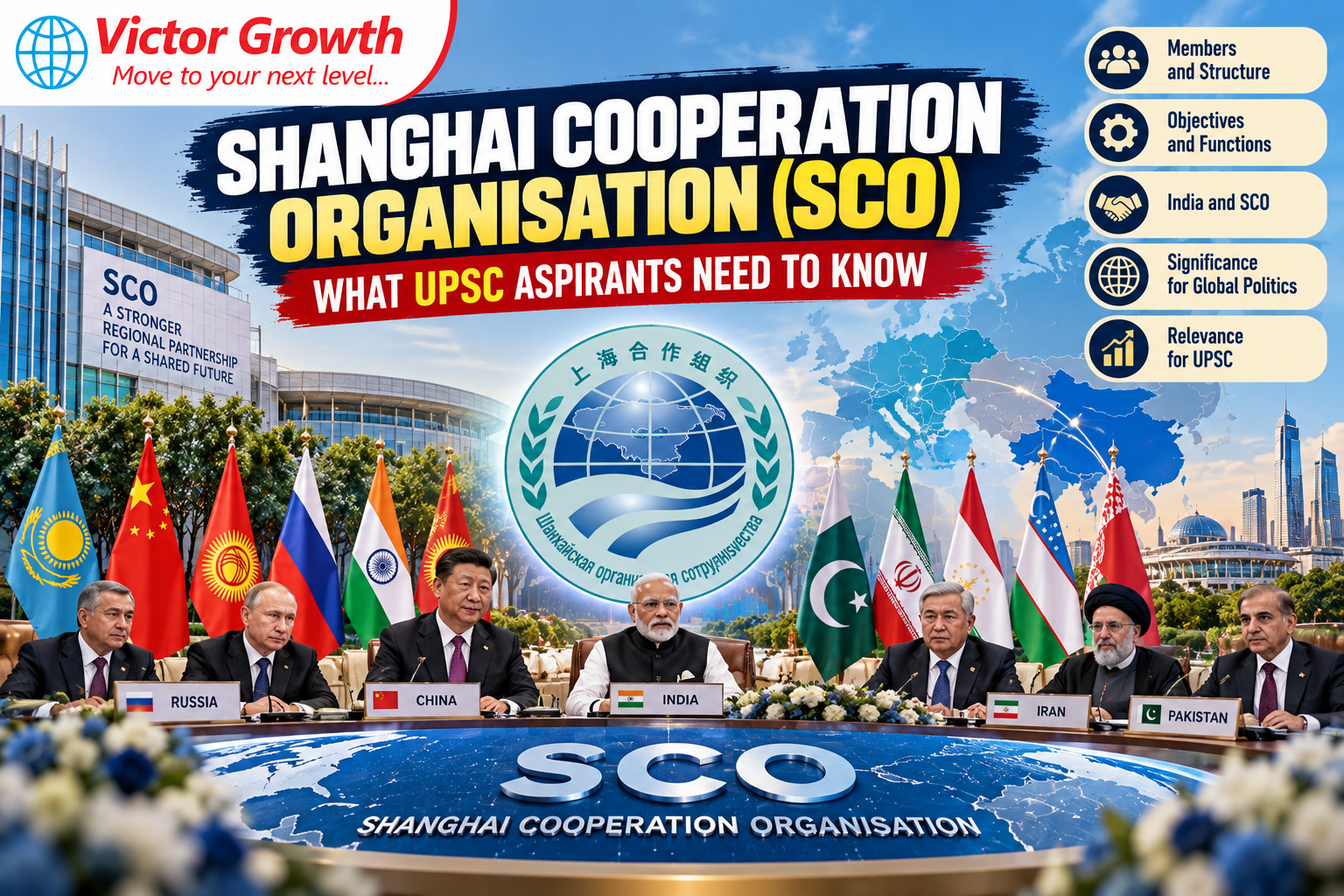
The Shanghai Cooperation Organisation (SCO) is an important Eurasian multilateral organisation dealing with security, economic cooperation, connectivity and regional cooperation.
For India, the SCO is particularly important because it provides a platform for engagement with China, Russia, Central Asian countries, Iran and Pakistan.
The SCO is therefore highly relevant for UPSC Prelims, GS Paper 2, Essay and the Interview.
1. What is the Shanghai Cooperation Organisation?
The Shanghai Cooperation Organisation (SCO) was established on 15 June 2001 in Shanghai, China.
It emerged from the earlier Shanghai Five grouping, which consisted of:
China
Kazakhstan
Kyrgyzstan
Russia
Tajikistan
Uzbekistan joined in 2001, leading to the creation of the SCO.
The organisation initially focused strongly on regional security and combating terrorism, separatism and extremism, but its agenda has expanded to include economic, cultural, technological and humanitarian cooperation.
2. Who Are the Members of SCO?
As of 2026, the SCO has 10 member states:
India
China
Russia
Kazakhstan
Kyrgyzstan
Tajikistan
Uzbekistan
Pakistan
Iran
Belarus
Iran became a full member in 2023, while Belarus joined in 2024.
Remember:
India joined as a full member in 2017.
3. SCO: Observer States and Dialogue Partners
Apart from full members, the SCO also has observer states and dialogue partners.
As of 2026:
Observer States
Afghanistan
Mongolia
Dialogue Partners
The group includes countries such as:
Saudi Arabia
UAE
Türkiye
Egypt
Qatar
Bahrain
Nepal
Sri Lanka
Maldives
Myanmar
Azerbaijan
Armenia
Kuwait
Cambodia
The exact categories are important for UPSC because member, observer and dialogue-partner status are different.
4. What Are the Main Objectives of SCO?
The SCO focuses on cooperation in several areas.
Security
Counter-terrorism
Countering extremism
Combating separatism
Counter-narcotics
Regional security
Economic Cooperation
Trade
Investment
Energy
Transport
Connectivity
Other Areas
Digitalisation
Science and technology
Culture
Education
Tourism
Healthcare
Environmental cooperation
The organisation’s agenda has therefore expanded beyond traditional security concerns.
5. The “Three Evils”
One of the most important concepts associated with the SCO is its fight against the “Three Evils”:
Terrorism
Use or threat of violence for political or ideological objectives.
Separatism
Movements seeking separation or territorial independence.
Extremism
Radical ideologies or activities considered threats to regional security.
For UPSC Prelims, remember:
SCO → Three Evils → Terrorism + Separatism + Extremism
6. Regional Anti-Terrorist Structure (RATS)
The SCO has a specialised mechanism called the Regional Anti-Terrorist Structure (RATS).
Its headquarters is located in:
Tashkent, Uzbekistan.
RATS focuses on cooperation against:
Terrorism
Separatism
Extremism
It is one of the important institutional mechanisms of the SCO.
7. How Does the SCO Work?
The Council of Heads of State is the highest decision-making body of the organisation.
It meets annually and provides overall political direction.
Other important mechanisms include:
Council of Heads of Government
Council of Ministers of Foreign Affairs
Council of National Coordinators
SCO Secretariat
Regional Anti-Terrorist Structure
The SCO Secretariat is located in Beijing, China.
8. Why Is SCO Important for India?
India’s membership provides an important platform for engaging with the wider Eurasian region.
India’s key interests include:
Security
Cooperation against terrorism and extremism.
Central Asia
Greater engagement with Kazakhstan, Kyrgyzstan, Tajikistan, Turkmenistan and Uzbekistan.
Afghanistan
The security situation in Afghanistan has implications for India and the wider region.
Energy
Central Asia, Russia and Iran are important energy and resource partners.
Connectivity
India seeks improved connectivity with Central Asia and Eurasia.
Multilateral Diplomacy
SCO provides a platform where India engages simultaneously with countries such as China, Russia and Pakistan.
9. India’s “SECURE” Approach
India has promoted the concept of a “SECURE SCO”.
SECURE stands for:
S – Security
E – Economic Development
C – Connectivity
U – Unity
R – Respect for Sovereignty and Territorial Integrity
E – Environmental Protection
This framework reflects India’s priorities within the organisation.
10. India’s Role in the SCO
India became a full member in 2017.
India hosted the SCO Summit in 2023 during its first SCO presidency.
During India’s chairmanship, India promoted areas such as:
Startups and innovation
Traditional medicine
Digital inclusion
Youth empowerment
Shared Buddhist heritage
India also emphasised counter-terrorism, connectivity, digital public infrastructure and sustainable development.
11. Why Is SCO Strategically Important?
The SCO covers a large part of Eurasia and brings together major powers and important regional states.
Its members include:
Major energy producers
Major economies
Nuclear powers
Central Asian states
Important transport corridors
This gives the organisation significance in:
Security + Energy + Connectivity + Trade + Eurasian geopolitics
12. SCO and India’s Strategic Autonomy
India simultaneously participates in several major international groupings.
For example:
SCO + BRICS + QUAD + G20 + ASEAN-related mechanisms
These groupings have different memberships and objectives.
India’s participation in SCO allows it to engage with countries such as Russia, China and Central Asian states, while its participation in other forums provides engagement with different strategic partners.
This reflects India’s broader approach of maintaining strategic autonomy and issue-based partnerships.
13. SCO and Connectivity
Connectivity is an important area of cooperation.
India’s geographical challenge is that it does not have direct land access to Central Asia because of Pakistan’s geography.
Therefore, alternative connectivity routes are important.
Important example:
International North-South Transport Corridor (INSTC)
India → Iran → Caspian region → Russia → Europe
Other connectivity discussions involve Central Asia, Afghanistan and wider Eurasian transport networks.
UPSC Concept
Connectivity = Trade + Energy + Strategic Access
14. SCO and Afghanistan
Afghanistan is important to SCO discussions because of:
Terrorism
Extremism
Drug trafficking
Regional security
Humanitarian concerns
Connectivity
Although Afghanistan is not currently a full SCO member, it has observer status.
For India, developments in Afghanistan are important because of their implications for national security and regional stability.
15. SCO and India’s Challenges
India’s participation in the SCO also presents challenges.
China-Pakistan Factor
India has significant differences with both China and Pakistan.
Connectivity Constraints
India’s land connectivity with Central Asia remains limited.
Diverging Interests
SCO members do not always have identical strategic or economic interests.
Russia-China Relationship
The growing strategic relationship between Russia and China is another factor India must navigate.
Therefore, India uses the SCO primarily as a platform for engagement and cooperation, while managing bilateral differences separately.
16. SCO vs QUAD
A common UPSC mistake is to treat every international grouping as an alliance.
| SCO | QUAD |
|---|---|
| Eurasian organisation | Indo-Pacific strategic grouping |
| Founded in 2001 | Revived at leaders’ level in 2017 |
| Strong focus on regional security and cooperation | Focus on a free, open and inclusive Indo-Pacific |
| Includes China and Russia | Includes India, USA, Japan and Australia |
| Has a broad Eurasian membership | Four-member grouping |
Remember:
SCO ≠ Military Alliance
It is a multilateral organisation with broad areas of cooperation.
17. SCO in the Changing World Order
The SCO has become increasingly relevant amid discussions about:
Multipolarity
Global South
Eurasian connectivity
Regional security
Reform of global institutions
At its 2026 meetings, the organisation emphasised a more representative and multipolar international order and continued cooperation in politics, security, economy and humanitarian affairs.
In September 2026, the SCO held its 26th Council of Heads of State meeting in Bishkek, Kyrgyzstan, marking the organisation’s 25th anniversary year. The chairmanship for 2026–27 passed to Pakistan.
UPSC Prelims Quick Facts
Founded:
15 June 2001
Headquarters:
Beijing, China
India became full member:
2017
Iran became full member:
2023
Belarus became full member:
2024
Current full members:
10
Observer states:
Afghanistan and Mongolia
Important security body:
RATS
RATS Headquarters:
Tashkent, Uzbekistan
Key security concept:
Three Evils – Terrorism, Separatism and Extremism
UPSC Prelims Practice Question
Consider the following statements regarding the Shanghai Cooperation Organisation:
India became a full member of the SCO in 2017.
Iran became a full member in 2023.
The SCO Secretariat is located in Beijing.
The SCO is a military alliance similar to NATO.
Which of the statements given above are correct?
Answer: 1, 2 and 3 only.
UPSC Mains Question
GS Paper 2
“The Shanghai Cooperation Organisation provides India with an important platform for engagement with Eurasia, but also presents significant strategic challenges.” Discuss.
Points to cover:
Introduction:
Briefly define the SCO and its significance.
Body:
India’s security interests
Central Asia
Counter-terrorism
Energy security
Connectivity
Afghanistan
Engagement with Russia and China
Strategic autonomy
Challenges:
China-Pakistan dynamics
Connectivity limitations
Divergent interests among members
Conclusion:
India can use the SCO as a platform for regional dialogue, connectivity and security cooperation while pursuing its independent national interests.
Quick Revision
Remember SCO through this chain:
SCO
↓
Eurasia
↓
Security
↓
Three Evils
↓
Central Asia
↓
Energy & Connectivity
↓
India’s Strategic Autonomy
Final Takeaway
The Shanghai Cooperation Organisation is important for UPSC because it connects several major themes of international relations:
Security + Central Asia + China + Russia + Iran + Pakistan + Afghanistan + Connectivity + Energy + Multipolarity
For Prelims, remember the members, headquarters, RATS and Three Evils.
For Mains, focus on India’s interests, strategic autonomy, connectivity, counter-terrorism and the opportunities and challenges of engaging with the Eurasian region.
UPSC Tip: Don’t study SCO merely as a list of countries. Study it as India’s gateway to Eurasian geopolitics.