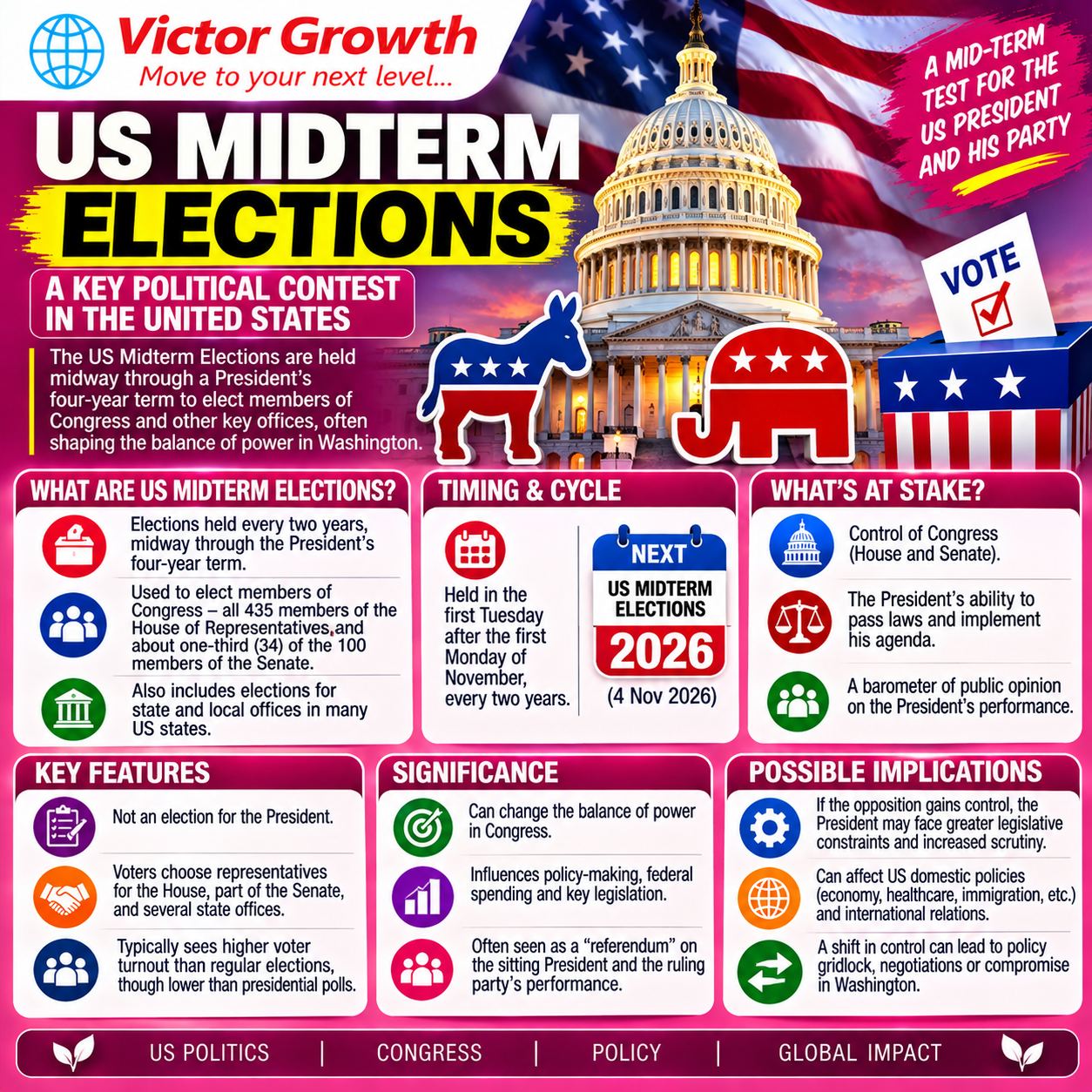
The United States conducted its 2026 Midterm Elections on 3 November 2026, halfway through President Donald Trump’s second presidential term.
The elections produced a significant political shift, with the Democratic Party winning control of both the House of Representatives and the Senate, according to Associated Press reporting on 4 November. The outcome represents a major setback for the Republican Party and President Trump. Some individual Senate races are still being counted. <Cite refs={[“turn992353news16″,”turn992353news9″,”turn992353news12”]}/>
What Are US Midterm Elections?
Midterm elections are elections held halfway through a four-year presidential term in the United States.
Unlike presidential elections, voters do not elect the President or Vice-President during midterms. Instead, they elect members of Congress and several state-level representatives.
The 2026 elections included:
House of Representatives: All 435 voting seats.
Senate: 35 seats, including regular and special elections.
Governors: Elections in several states.
State legislatures: Various state-level legislative and local contests.
The newly elected Congress will be the 120th US Congress, scheduled to begin in January 2027. <Cite refs={[“turn992353search1″,”turn992353news14”]}/>
Major Results of the 2026 Midterm Elections
The Democratic Party gained control of both chambers of Congress.
Republicans lost their earlier majorities in the House and Senate.
The results reflected voter concerns over inflation, cost of living, the economy, the Iran conflict and government accountability.
The election is being viewed as a major political setback for President Trump.
The results could influence the political environment ahead of the 2028 presidential election. <Cite refs={[“turn992353news16″,”turn992353news9”]}/>
Why Are Midterm Elections Important?
1. Legislative control
The party controlling Congress has considerable influence over legislation, government spending and national policy.
2. Presidential accountability
Midterm elections act as a public assessment of the President’s performance during the first two years of the term.
3. Congressional oversight
A change in the majority can alter committee leadership, investigations and oversight of the executive branch.
4. Policy direction
Congress influences decisions relating to taxation, healthcare, immigration, defence, foreign policy and economic development.
5. Impact on the next presidential election
Midterm results can influence party leadership, political alliances and candidate selection ahead of the next presidential election.
Structure of the US Congress
The US Congress is the legislative branch of the federal government and consists of two chambers.
| Feature | House of Representatives | Senate |
|---|---|---|
| Total membership | 435 voting members | 100 members |
| Representation | Based on population | Two senators per state |
| Term | 2 years | 6 years |
| Election cycle | Entire House every 2 years | Approximately one-third every 2 years |
| Presiding officer | Speaker of the House | Vice-President of the US |
The Senate is a continuing body because only a portion of its membership is elected every two years.
Implications for President Donald Trump
The change in congressional control can create significant political and legislative challenges for the President.
Legislative challenges: Passing major bills may become more difficult.
Congressional investigations: Democratic leaders can exercise greater oversight of the administration.
Budgetary control: Congress plays a major role in approving federal expenditure.
Appointments: The Senate has an important role in confirming presidential appointments.
Checks and balances: The outcome demonstrates the importance of institutional checks within the American political system.
However, the President retains executive powers, including the power to veto legislation, subject to constitutional limitations.
Implications for India
The US is one of India’s most important strategic and economic partners. Changes in congressional control may influence:
India–US relations: Congressional discussions can shape defence, technology and strategic cooperation.
Trade relations: Legislative debates may affect tariffs, trade policy and economic cooperation.
Immigration: Changes in political priorities could influence H-1B visas and immigration policy.
Defence cooperation: Congressional support is important for defence agreements and strategic partnerships.
Indo-Pacific strategy: US policy towards China, the Quad and regional security remains important for India.
US Midterm Elections vs Indian General Elections
| Basis | US Midterm Elections | Indian General Elections |
|---|---|---|
| Frequency | Every 2 years for Congress | Every 5 years for Lok Sabha |
| Main purpose | Elect Congress and other state officials | Elect Lok Sabha members |
| Executive head | President elected separately | Prime Minister emerges from parliamentary majority |
| Upper House | Senate elections are staggered | Rajya Sabha is a continuing body |
| Electoral system | Mainly single-member plurality elections | First-Past-the-Post for Lok Sabha |
UPSC Examination Relevance
Prelims: US Congress, House of Representatives, Senate, midterm elections, separation of powers and checks and balances.
Mains – GS Paper II: Comparison of the Indian and American political systems, bilateral relations, international institutions and global political developments.
Possible UPSC Mains Question:
“Examine the significance of US midterm elections in shaping the relationship between the executive and legislature. How can changes in congressional control influence India’s relations with the United States?”
Conclusion
The 2026 US Midterm Elections demonstrate the importance of legislative accountability and democratic checks and balances. The change in congressional control could reshape domestic policymaking and influence America’s international engagement. For India, maintaining strong bipartisan relations with the United States will remain important irrespective of which party controls Congress.